Showing posts with label hairstyling. Show all posts

Sunday, 15 October 2017

To Air-Dry or Not to Air-Dry Your Hair?!


THE BEAUTY BRAINS, generally a good authority on all things beauty-related wants you to air-dry your hair - and has been a common opinion for a quite a long time.

"It’s more damaging to blow dry or towel dry your hair than it is to let it air dry. It’s as simple as that. That’s because heat from blow dryers can mess with the natural lipid distribution in your hair AND degrade the intercellular cement that holds the hair’s protective cuticle in place. And the physical abrasion from towel drying not only loosens healthy cuticles but can actually wear them away! So if you dry your hair a lot you’ll end up with less shine and more split ends." 
 
Read more: Source

But REALLY REE posted about recent research (Sept 2017), indicating that gentle blow drying might be the way to go.

"Hair is most vulnerable to damage when it is wet. The results documented in the published paper referenced above show that letting hair dry naturally causes the cortex (the thickest layer of hair) to swell and become weaker, as the swelling puts pressure on the delicate proteins that hold hair together. By leaving the hair wet you are effectively leaving it in contact with water for a longer period which means it’s in its weakened state for longer and therefore vulnerable to more damage." 
"Further research carried out at the ghd Research & Development centre in Cambridge has shown that using a hair-dryer at the right distance, correct temperature and using a precise step by step method can actually cause less damage than letting hair air-dry." 
Read more: Source

Air-drying damages the inner cortex, while blow drying damages the outer cuticle. There's a trade off. And of course ghd, who makes and sell heat styling tools, would claim damaging the cuticle with blow dryers is the lesser of two evils - but I'm not sure what to think.

I think research carried out by, or funded by, companies who would make significant profits of a "positive" result are definitely biased and not reliable. That doesn't mean that they're necessarily wrong either, so it's difficult to know what to believe. (I don't specifically have anything against ghd, though. Many global companies do this.)

In this case, I think for me it's worth testing out whether e.g. blow drying on medium-cool with heat protectant reduces damage in the long run, but I wouldn't blame any fellow longhairs who aren't ready to risk it. The longer and "older" your hair gets, the more delicate it gets too after all, and I'm not at super-long lengths just yet!

Sunday, 10 September 2017

Historical Haircare Part 3: Viking Hairstyles


Hair knot with a tail


Originally I started up this Historical Haircare series because I have an interest in the Viking Age - ever since my childhood, really. I grew up learning about the history, legends, and mythology in school. My parents would read the legends and mythology as bedtime stories. As I grew up, I developed an interest in how different people see the world differently - both in other cultures and other historical ages. As I forayed into haircare, and found lots of interesting things about contemporary haircare in different culture (e.g. Afro haircare, Ayurveda, etc.), I started wondering about those Vikings. What did they do? I googled around and found this excellent page, the Viking Answer Lady Webpage, and she has a whole article on haircare! The article goes over both male and female hairstyles, and washing. I'm going to outline particularly female hairstyles, such as the one above, but as an aside-note - it seems Vikings were pretty clean, compared to most other people around that Age!

Onto hairstyling! Coronet type head bands called "fillets"" were not uncommon all over Europe. Head dressings, and hoods, with the hair knotted at the neck seem to have been more common in the Christianised areas. But above all, the knotted hairstyle above seems to be the most prevalent hairstyle depicted for Viking Age women where it's not immediately obvious if they wore a head cover or not. It shows up in many figurines and the like. It's not clear if it's just long hair twisted into a knot with a ponytail, a similarly knotted braid, or perhaps a scarf around the head that is knotted at the nape of the neck and the tail left hanging loose.


Hair knot without a tail

 
Historiska

There are a few variations of the hair knot around, such as this one. It could be interpreted as a knotted head cover, or maybe a coronet, braids across the scalp, and a knot at the neck. It's difficult to know for sure.


Double hair knot

https://www.flickr.com/photos/28772513@N07/4560502772/

This lady could be wearing her hair in double "sailor moon"-type knotted buns, or as mentioned frequently, a double knotted head covering. Personally, I'm wondering if the stripes could represent hair, or perhaps several braids.


Very detailed hair knot with a tail

Photo: Jan Hein

This little figurine is the reason I'm convinced at least some wore their hair knotted, not just a head covering. If you look at the first and middle pictures, you can see that she has a middle part! Now, if the striped look of the hair is representative of hair strands or small braids is another issue, but according to the Viking Lady Answer Webpage article linked before, women seemed to wear their hair both loose and in braids sometimes, so either is possible I suppose.

Modern adaptations

Despite not having clear cut answers to just how Viking women wore their hair, this only peaks my interest and creativity. Sure, it would be cool to know just exactly what they looked like - but we don't. I find myself enjoying creating various hairstyles inspired by these depictions instead! Now, I'm most certainly not the first one to do that, but I still want to document my process.

Comet bun

After having a looksie around LHC and not finding what I was looking for, I posted a newbie question and got a great response from user enting that set me on the right track. A knotted bun with a tail is called a "comet bun"! I'd never heard of that before, but it was just what I was looking for. I googled around a bit and found a few tutorials. My favourite is probably the one by happy hair days. She, in turn, referenced Torrinpaige's video on YouTube "Knot Bun", which I also found helpful. Basically, you just take all your hair and do a single knot. You can either leave the tail hanging, or wrap it around the bun similarly to how you wrap your ends around a cinnabun. My hair is über-slippy so I would secure the bun with mini-hairclaws around the perimeter. I suppose your could use hair pins, spin pins, or whatever you prefer as well. I don't know what ladies used in the "Days of Yore" but I'm not too fussed either way. This method would give you the look of how I imagine the first two pictures, and the last, would have look liked in real life. You could also use this method to create the "Viking sailor moon"-look in the third picture, but with smaller buns high on your head.

Comet cinnabun

Unfortunately, my hair is too short still to do a proper knot bun at all - with or without a tail. So, until my hair grows, I'll just have to make do with a cinnabun. Here, I take the majority of my hair and clip it forward out of the way. I leave a little bit at the center of my neck hanging, enough to french braid it two or three turns before braiding it to the ends. I then take the rest of my hair and cinnabun it on top of the beginning of the little french braid. This way, it looks like the braid starts in the bun.

Protective scarf

Personally, I'm not one for head coverings. It's not part of my religion or culture, and sometimes I just find it difficult to incorporate methods from different cultures without being appropriative. What is and isn't appropriative is often unclear to me, so I tend to stay away until I know more. That's my personal choice, and I don't expect the same from anyone else.

Still, I do sort of wear head coverings at home, sometimes. When I deep condition, I slather my hair with oil, deep conditioner, mayo, whathaveyou, put a shower cap on, and in the summer I tie a scarf around it. This makes it look nicer, and helps the body head to stay trapped in the hair. Of course, the shower cap does that quite well on it's own, I just like having a scarf over it anyway. (During winter I may put a wool cap over the shower cap instead, but that's a bit too warm during the summer months.) Often I tie the scarf in a knot at the nape of my neck simply because that's the easiest way of securing it. I tie it off first with an elastic, and then I knot the scarf around the elastic for aesthetic reasons. Coincidentally, it looks just like the Viking figurines above...


I hope this was interesting! I just focused on the parts that I personally find the most interesting and worth my while, but I've mentioned the other topics and linked all sources so I can return to them in case I want to read up more.

~ Siv

Tuesday, 18 July 2017

Historical Haircare Part 1: 19th Century Hair Styling

Introducing a new series! I was recently inspired by a post on Makeup Mania called "Scandinavian Hairstyle". It prompted readers to take hairstyle inspiration from cultures all over the world. Quite neat, I think! My own spin on this will be taking inspiration from different epochs of "my own" culture. I've done a bit of reading on Viking hairdos, but that whole topic is quite a labyrinth, so I'll have to put some more effort into it before I post on that topic. But, it will be on here, in the near future!

In the meantime, I've browsed through quite a few portraits of queens from days of yore (i.e the 19th century)!


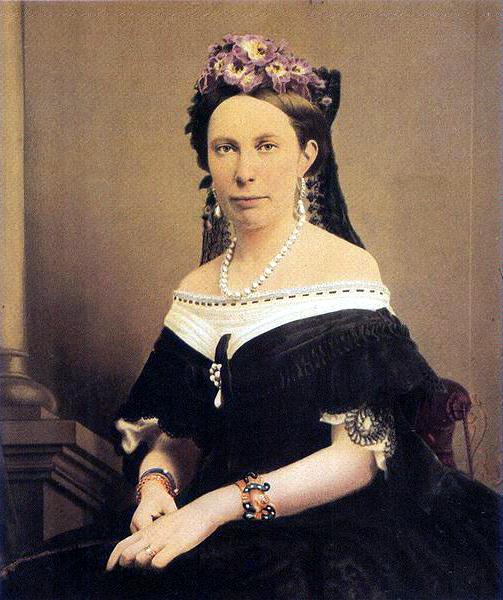
First, a couple of queens with similar hairstyles. Queen Lovisa of Sweden, circa 1865 and Queen Sofia of Sweden, circa 1872.


What's going on here? Well, a nice length of those 19th century rag curls, and a poofy top with a (flower) crown! Now, I'm not about to start wearing a crown (flowers or no flowers!) and those rag curls are a bit too high maintenance for me, BUT I can appreciate the extremely styled aesthetic. Though, again, too much effort for me - and with my particular brand of hair it wouldn't hold more than an hour or two anyway. So what can I actually take from these portraits? Personally, I've somewhat wavy but mostly straight hair. With a bit of gentle combing I can get it pretty straight without any damage. So, a half-up with straight lengths down my back is entirely doable with little effort. The key, I think, would be to not leave any hair hanging in front of my ears, like a lot of contemporary stylish half-ups seem to do. Now, as for the poofy top... I think two or even three french braids are actually my solution. In my hair, french braids tend to look less like braids and more like poof on the crown on my head. My hair is kind of slippy and doesn't like to stay in place. With a bit of gentle tugging on the braids I think I could work up some good volume.

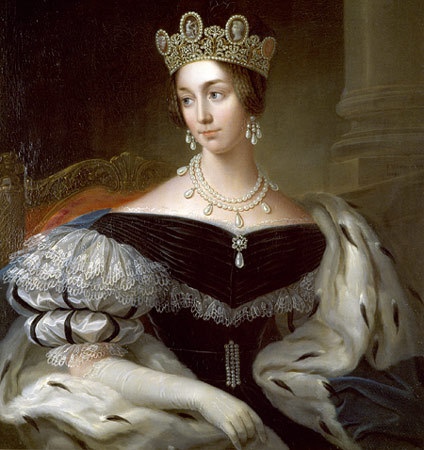
Now, the second hairstyle for this post, is a particularly interesting updo sported by Queen Josephine of Sweden & Norway, 1837. 


Why particularly interesting, you ask? I'm not sure it's particularly unique for the time period (I've no idea, actually) but I've a secret (or not so secret) love for braids. Woe is me, because my slippy hair doesn't like to be contained in braids. Numerous little braids are particularly enchanting to me, because I can't really sport it without somehow feeling like someone is going to think that I'm appropriating Afro culture. And I've no intention on starting up a debate on that topic here and now, I'm just mentioning it because this portrait gave me an idea. See, I'm not all that into this braided Princess Leia buns vibe that Queen Josephine has going on, but I'm imagining perhaps one bun, on the top of my head? First the hair is pulled into a high ponytail with a nice non-damaging hair ties - off-brand invisibobbles are my go-to - then the tail is braided into numerous little braids and secured with small elastics. Then, the braids are swirled into a bun and secured with a weapon of your choice - I like scrunchies, but I could totally imagine a regular elastic (if you're not worried about mechanical damage) or even a hair stick or hair fork. I'm not sure if hair pins would work, but perhaps someone else can come up with a trick for that? I would feel comfortable and non-appropriative in that sort of hairstyle, as it would have a different aesthetic than what I, at least, associate with Afro culture.

x